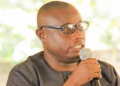
Arocha Ghana in partnership with the International Union for Conservation of Nature (IUCN) has held a sensitization workshop for stakeholders on One – Health approach in Damongo.
The workshop which was held on Tuesday, 11th April, 2023 is an initiative being
implemented and in its second phase of a project titled “Stabilizing Land use Project” in Protected Area (PA) Categories V and VI as landscape mechanisms for enhancing biodiversity in agricultural land, ecological connectivity and REDD+ implementation also known as PLUS’.
The phase II of the project focuses on the
link between One – Health (OH) and landscape approaches to improve biodiversity conservation.
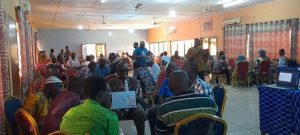
The main objective of the workshop is to educate stakeholders and share lessons on how the forest and land use planning sectors can integrate One – Health approaches and discuss how health and other experts can benefit from this work and knowledge.
One Health is a collaborative, multispectral, and transdisciplinary approach working at the local, regional, national, and global levels with the goal of achieving optimal health outcomes recognizing the interconnection between people, animals, plants, and their shared environment.
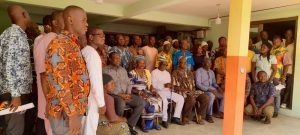
In a welcome Address, the project officer at Arocha Ghana, Mr. Isaac Kofi Ntori explained that the project was implemented in 2017 with a long-term goal to achieve conservation and development benefits through better use of Protected Area categories V and VI or other appropriate area-based conservation mechanisms.
He also explained that the second Phase of the project which was completed in the year 2020 is now in progress in other to better conserve biodiversity in the landscapes that are designated as the target landscapes (Mole Ecological Landscape) through which the phase stresses the connections between One – Health and landscape approaches.
He further explained that, one – Health is a philosophy that emphasizes on the connections between the health of people, animals, and the environment with a strategy that encourages interdisciplinary and cross-sector cooperation to create coordinated efforts to lessen dangers to human, animal, and environmental health.
He also added that, Landscape approaches which provide concepts and procedures for managing and assigning land to achieve social, economic, and environmental sustainability expresses the need to strike a balance between competing land use demands in a manner comparable to that of the need.
He also stated that, in an integrated One – Health and landscape approaches, human health is recognized as being vital to conservation which is a factor that is typically disregarded in conservation efforts.
According to him, the COVID-19 pandemic has highlighted the need for protected areas and OH policies which has helped in promoting ecosystem conservation and avoiding risks to human health.
The major goals of the sensitization workshop was to inform participants, share best practices and explore on how the one health movement may be incorporated into the forest and land use planning sectors.
The Project Assistant at the International Union for Conservation of Natural resources, Mr. Anthony Adeea Mba on his part explained that, the overall mission of the One – Health project is to have a just world that will care and conserve Natural Resources in the landscape which has a lot of resources and potentials.
He added that, their efforts on protected areas and the OH policies need the involvement of all stakeholders to contribute their quota to ensure that the resources are conserved and protected by enriching their capacity and ensuring that the communities gets benefits that will help them conserved and protect the biodiversity and landscape for now and for future generations.
He also explained that, the One health (OH) approach is a new concept that will enable participants to streamline their activities into having a unified unity that can approach their complex issues as one.
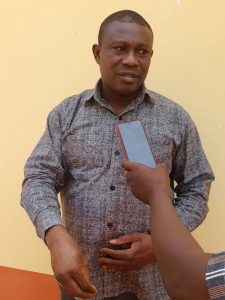
The Savannah Regional health Director, Dr. Chrysantus Kubio who took participants through a presentation on the One Health approach in an interview with our reporter explained that, the one – health approach attempts to look at how to holistically handle health issues including human, animal and environmental health within the Mole ecological landscape, noting that there are a lot of issues that cut across the various health components and therefore important for all sectors to collaborate to be able to handle some of the health issues causing threats in the ecological zone.
He also noted that some of the health issues such as rabies affects both humans and animals which should not be tackled only at the human aspect but should be controlled among animals to avoid its prevalence.
Dr. Kubio also remarked that, intersectoral collaborations is key to be able to tackle some of the disease conditions in the ecological landscape, adding that a lot of Districts are bordering the zone which calls for a more collaboration efforts to be able to identify early what the health priorities are, in relation to the ecological zone.
He also indicated that, in their discussions, they realized that normadics comes into the ecological zone without any checks and appealed that there is the need to people who will be able to identify who comes into the ecological zone and its disease implications that are there in the areas where the people are settled so that they can reach out to them as the usually get into contact with the animals.
He also noted that, the destructions along the Mole Park also has an effect on biodiversity causing some of the animals to relocate and urged all key stakeholders to play a role to ensure that they are able to conserve the area and also ensure that they are able to protect the animals and as well see to how to incorporate the one health issues into the management of the landscape so that together, they will be able to protect the wildlife and also protect the humans who live around the landscape.